For many UK advice firms, the suitability report is where growth stalls. Advisers can see more clients than the firm can produce reports for. Clients wait. Paraplanners are stretched. The work between the meeting and the issued report becomes the constraint.
That is uncomfortable, because the suitability report matters. It is a core part of how a firm explains its advice to a client, and it needs to be right. The problem is not that reports take care. It is that a lot of the time goes into work that is not the careful part.
This article looks at why suitability reports slow advice firms down, what to measure in your own firm, and where the biggest opportunities usually sit.
Quick answer
Suitability reports slow firms down because producing one involves gathering information from several places, structuring it into the firm's template, writing client-specific reasoning, chasing missing details and going through several rounds of review, often handled by a small number of people. Much of that time is assembly and coordination, not judgement. Firms can find where their own time goes by measuring stages and reasons for delay.
Why the report is such a bottleneck
It sits at the end of a long chain
A report depends on everything before it: the meeting, the fact-find, the research, the recommendation. Any delay upstream shows up as a delay in the report. But the report is also the point where the delay becomes visible, because it is what the client is waiting for.
It relies on a small number of people
In many firms the report is written by one or two paraplanners for several advisers. That is a lot of demand on a few people. When one is off or overloaded, the queue grows.
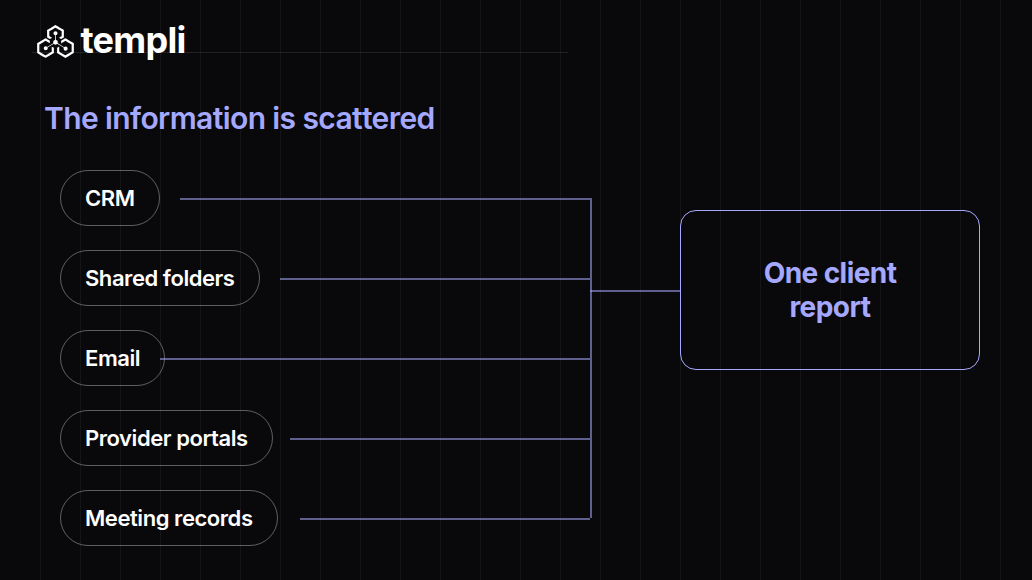
The information is scattered
Client information often lives in a CRM, shared folders, emails, provider portals and meeting records. Bringing it together takes time before any writing happens.
The work is repetitive in shape, but not in content
Many sections follow familiar patterns: objectives, risk profile, existing arrangements, recommendation, risks, charges. The shape is repetitive but the content has to be right for each client. That means it cannot be copied, but it does take effort to assemble every time.
Review is necessary, and it stacks up
Good review is not the problem. But when a draft needs several rounds, each round adds waiting time for people with busy diaries.
Standards are high, and rightly so
Suitability reports need to be clear, accurate and specific to the client. That standard is the reason they take care. The aim is to spend that care on the parts that need it.
What it costs the firm
The cost of slow reports is not just the paraplanner's time. It shows up in several places:
- Adviser capacity. Advisers who are waiting for reports, reviewing them or answering queries have less time with clients.
- Client experience. Clients waiting for a report may feel the process is slow or uncertain.
- Growth. If report production is the constraint, taking on more clients or advisers does not translate into more delivered advice.
- Team wellbeing. Paraplanners under constant pressure are more likely to feel stretched, and firms with stretched teams find it harder to keep them.
- Consistency. When people are rushed, the risk of missed details or inconsistency goes up.
The point is not that a firm should rush its reports. It is that the capacity of the firm should not be capped by the amount of assembly work each report needs.
See how Templi works.
Templi helps advice teams take on the assembly work around suitability reports — drafting inside the firm's own templates, flagging gaps early and keeping review and approval human.
Where does your time actually go?
Before looking for fixes, find out where the delay is in your firm. A simple exercise is to track a sample of reports through each stage and record how long they spend in it, including waiting time.
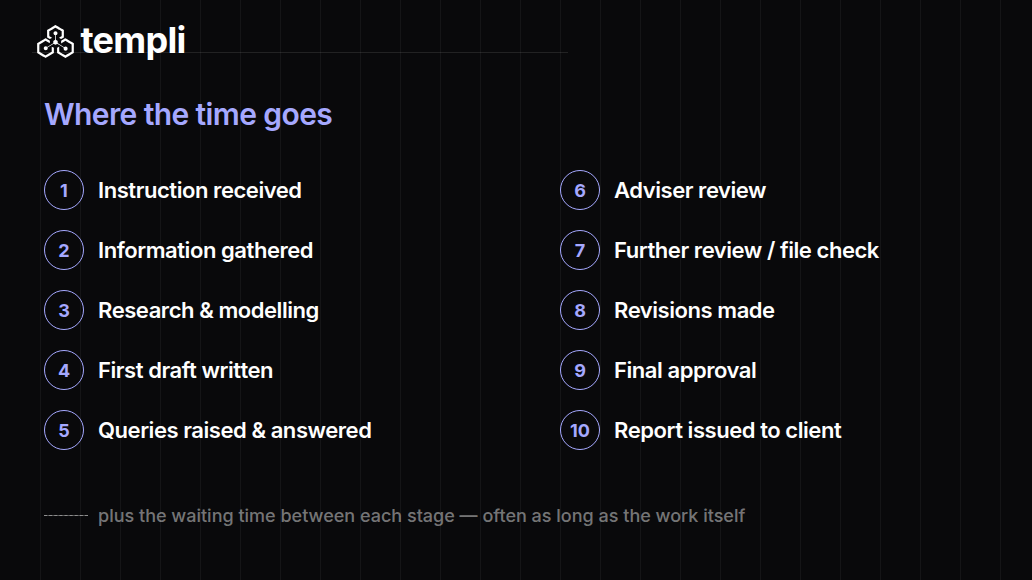
Stages might include:
- Instruction received from the adviser
- Information gathered
- Research and modelling completed
- First draft written
- Queries raised and answered
- Adviser review
- Further review or file check
- Revisions made
- Final approval
- Report issued to the client
For each, note both the working time and the waiting time. Many firms find that waiting time between stages is as significant as the work itself.
Also record the reasons for delay. Was information missing? Was the instruction unclear? Was someone unavailable? Did the recommendation change? Was the template not followed?
Do this for a few weeks. The pattern will show you where to act.
What tends to help
What helps depends on what the measurement shows, but several themes come up often.
Better handover. A structured instruction from the adviser reduces queries and interpretation.
Earlier gap detection. Finding missing information before drafting saves rounds later.
Template-native drafting. Working inside the template reduces manual copying and drift.
Clear review standards. A shared checklist makes review more consistent and predictable.
Capacity where it is needed. Sometimes the answer is another pair of hands, in-house or outsourced. We compare options in paraplanning services vs suitability report software.
Workflow support. AI-assisted workflows can take on parts of the assembly work: pulling information into the template, drafting first versions of sections and flagging gaps. They do not remove the need for adviser judgement or human approval.
What good looks like
In a firm where suitability reports are not the bottleneck, you would expect to see:
- Clear instructions that rarely need clarification
- Gaps flagged early
- Drafts that arrive in the firm's template and wording
- Reviewers who know what they are checking
- A visible record of versions, comments and approvals
- Paraplanners spending more of their time on analysis and quality, and less on assembly
- Advisers with more time for clients
None of that requires cutting corners on review. It requires putting effort in the right places.
What this means
Suitability reports slow firms down not because they matter, but because too much of the time around them goes into assembly, waiting and rework. The best first step is to measure where the time goes in your own firm.
From there, the fixes tend to be practical: a clearer handover, earlier gap flags, drafting inside the firm's template, consistent review standards, and workflow support for the assembly work. The aim is a firm where admin does not set the ceiling on growth, and human advice stays human.
Next step
More time with clients. Less admin.
Templi is an advice-native AI workflow system for UK advisers and paraplanners. It helps teams draft suitability reports inside their own templates and existing systems, with reviewable outputs, visible sources and human approval at every step. It takes on the work between client conversations, so your firm can spend more of its time on the advice itself, and there is no change to how your firm works.